As I write this, the world is in the midst of the Covid-19 pandemic, impacting the majority of humanity either directly or indirectly. Today, during a chat among green building professionals, a question was posed: “In what ways do you think the world will be different when this is all over?” My thoughts immediately shifted to the economic fallout, and my answer expounded on specific factors I’m concerned about and how I’ll respond accordingly. I missed a big point of the question though, while others grasped it right away. Following this shared collective experience, humans are unlikely to interact with their buildings quite the same way ever again. After prolonged periods of sheltering in place, many of us will be much more cognizant of the ways that our spaces are impactful to us, both positive and negative. The factors that go into determining whether spaces are contributors or detriments to wellness include natural lighting, thermal comfort, acoustics, air quality, and others. While LEED addresses many of these as credits in building design, WELL takes these elements on a deeper dive and ties them into human health.
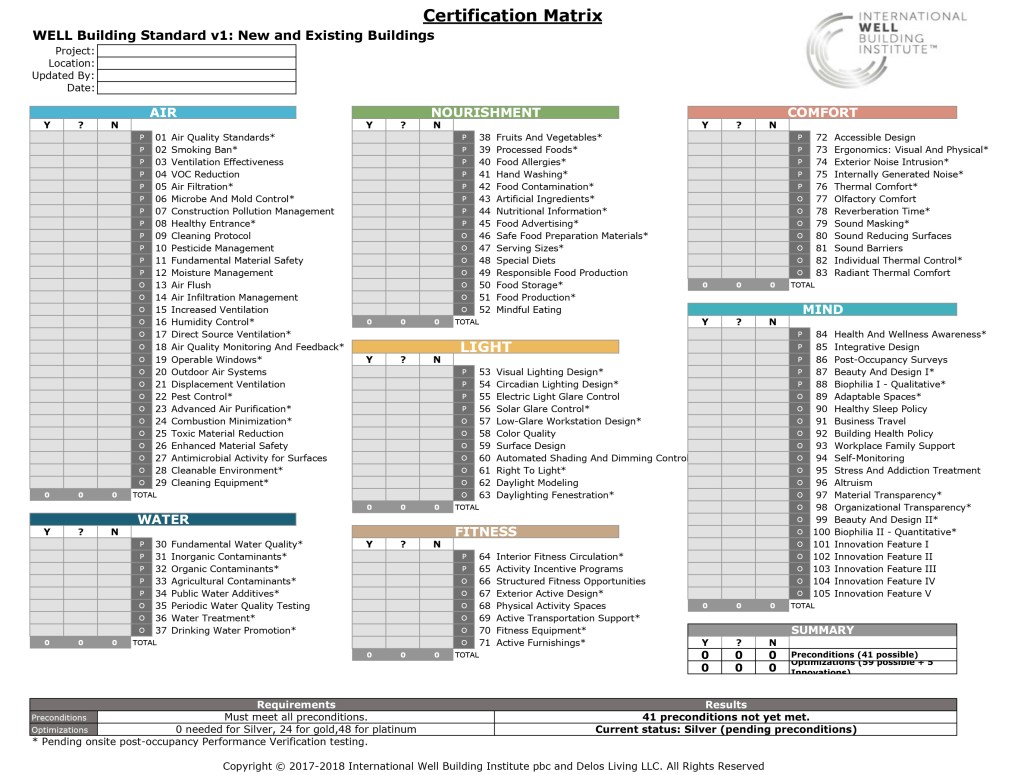
During today’s chat, we issued a challenge to each other about how me might integrate principles of WELL into projects, especially projects where WELL certification is not being pursued. As noted by one of my colleagues: “the building science and health science behind WELL Features are just as valid whether the building earns a plaque or not.” LEED has several notable examples of the same logic, with principles being important even when a credit can’t be earned, the most prominent in my mind being the Daylighting credit. Daylighting is frequently factored prominently into design for many projects, but dramatically less often is the corresponding LEED point achieved. For me to being to try to implement WELL principles, I was going to have to overcome one big fundamental challenge first. If I’m being honest, I’m woefully behind many of my green building colleagues in learning about WELL. It’s even something I’ve felt a little self-conscious about losing my edge as I watch my LinkedIn feed fill up with WELL AP’s over the last few years. Also, like many people in my 30’s, I’m taking an increased interest in my own health & wellness and making associated lifestyle changes to live a longer, fuller life. Sheltering in place during this public health crisis seems like the right time to stop making excuses and combine separate personal and professional interests to earn my WELL AP credential!
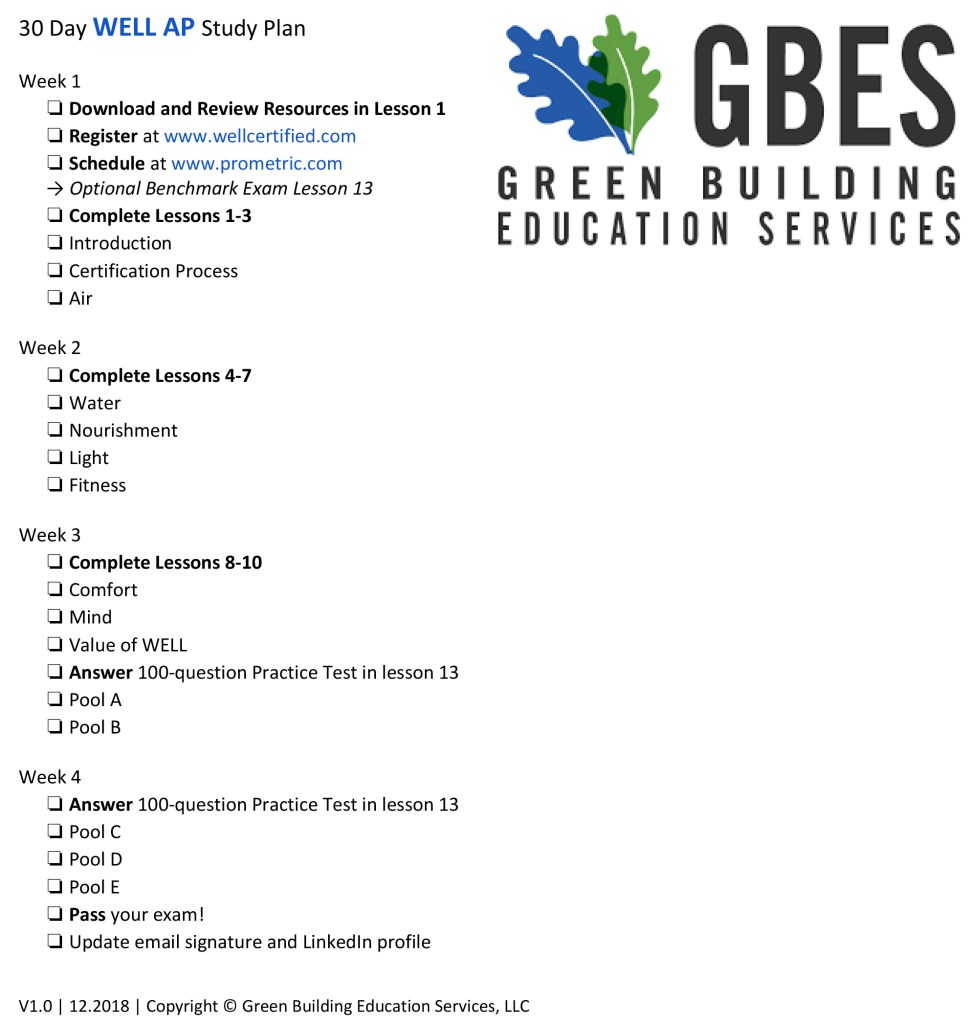
To help me prepare for this exam, I’m using the WELL AP Platinum Pack from GBES. I’ve known GBES CEO Charlie Cichetti for several years and know that they have a really good track record of success, including internationally. Back in 2009 when I was studying for the LEED AP exam, having access to multiple versions of the practice exam was a key for me. When I look back on it, I just don’t think I would have been able to understand why I was missing some questions otherwise. To study for WELL, I knew I wanted to have the same kind of tools available. From the 30 Day Study Plan seen below, you’ll see one of the first steps is the optional Benchmark Exam. As I expected, the 85 question exam kicked my butt pretty good, but I was very pleased to establish a baseline. The exam itself was extremely illuminating to get some insight into the subject matter, questions, topics addressed, etc. To the credit of GBES, the post-exam breakdown was even more insightful as to what WELL Feature categories I need to focus on throughout the rest of this journey (spoiler alert: all of them need some help). Unfortunately, I did not get a screenshot, but I’m going to take it again before I really start learning so I can track my progress here. I’m excited to see how this journey pans out and I hope others find it helpful in their own journey.

 Adventures in Green Building